35 Million Nigerians with Disabilities — But How Accessible Are Our Universities?
What does JONAPWD's assumptive disaggregated data mean for higher education in Nigeria?
EvriCampus
3/14/20263 min read
Recent assumptive demographic data released by the Joint National Association of Persons with Disabilities (JONAPWD) offers one of the clearest pictures yet of the scale of disability in Nigeria. Using the widely accepted global benchmark that persons with disabilities constitute roughly 15% of a country’s population, the report estimates that about 35 million Nigerians are living with disabilities, which is roughly 1 in every 6 Nigerians.
What this means is that persons with disabilities represent one of the largest minority groups in the country. In Nigerian higher education, students with disabilities remain grossly underrepresented. Available estimates suggest they constitute less than 1% of enrolled students in universities and other tertiary institutions. The question that should keep every stakeholder awake, we guess, is: where are the missing students?
The scale of the challenge
The JONAPWD data also highlights how disability is distributed across Nigeria. States with large populations unsurprisingly record the highest estimated numbers of persons with disabilities. Kano alone is estimated to have over 2.5 million persons with disabilities, while Lagos has about 2.1 million. Other states with significant numbers include Kaduna, Oyo, and Bauchi.
These numbers matter for higher education planning. Each of these states hosts several universities, polytechnics, and colleges of education. If even a small proportion of young people with disabilities in these states aspire to attend university, how prepared are these institutions to support them? As you can see, the data throws more questions than answers and puts a number to the scale of the challenge we face as a nation that seeks not to leave anyone behind.
A data gap at the heart of the problem
One of the most important observations presented in the JONAPWD report is that the figures themselves are assumptive estimates produced in collaboration with the National Population Commission within the 2025 national census projections.
Nevertheless, Nigeria still lacks a systematic disability data infrastructure, and without reliable data, inclusive policy becomes extremely difficult to implement.
Governments cannot plan effectively. Universities cannot benchmark their progress. Students with disabilities cannot easily identify which institutions might best support them.
In many cases, prospective students and their families must rely on rumours, informal networks, or chance encounters to learn whether a campus is accessible.
What this means for campus accessibility
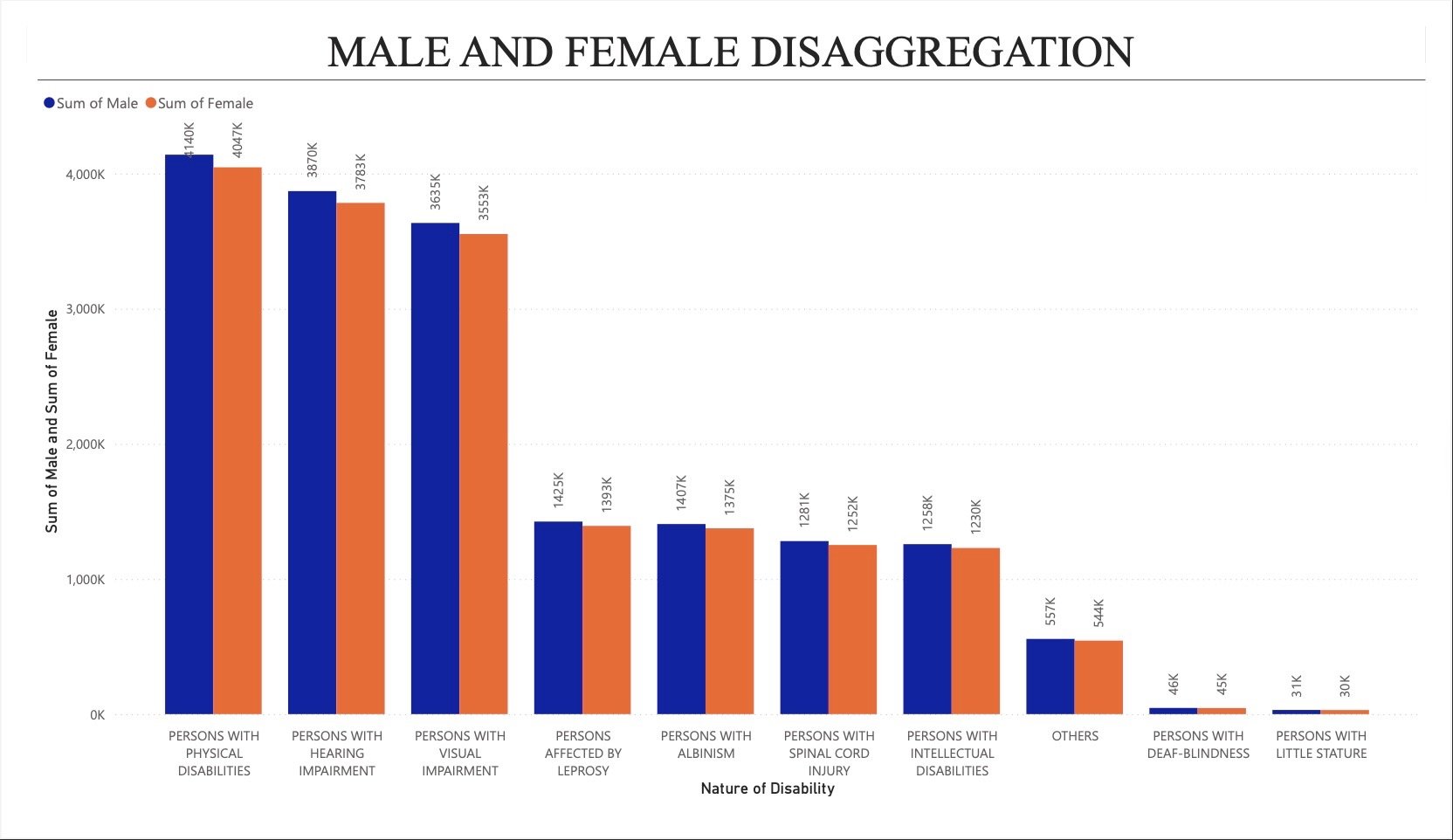
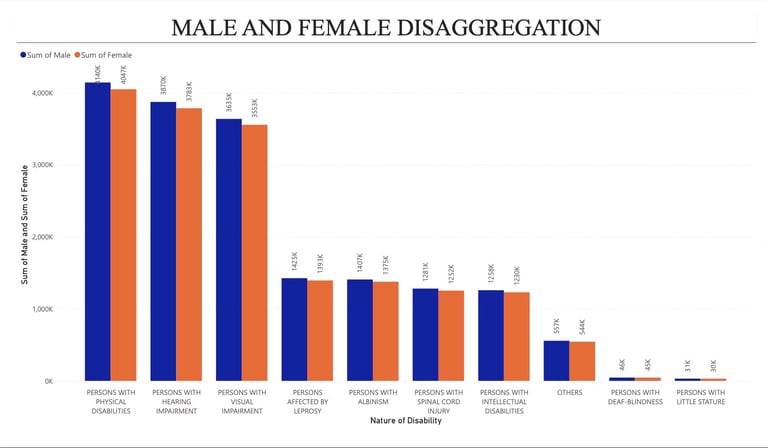
The JONAPWD analysis also shows that the disabled community is not monolithic. The largest clusters include persons with physical disabilities (8.2 million), hearing impairments (7.7 million), and visual impairments (7.2 million), each numbering several million nationwide.
For higher education institutions, this diversity translates into different accessibility needs such as wheelchair-accessible lecture halls and hostels, screen-reader compatible learning management systems, captioning and sign-language interpretation, accessible transport and campus navigation, and inclusive teaching and assessment methods. But only a very few universities have or even publicly document whether such provisions exist.
This is precisely the gap we seek to address at EvriCampus. We are building a public platform that documents campus accessibility across African higher education institutions, starting with Nigeria. Through student-led campus profiles, accessibility indicators, and institutional engagement, the platform aims to make accessibility visible.
If Nigeria may have 35 million persons with disabilities, then the drive towards making our campuses accessible must become part of the national infrastructure of universalising social mobility opportunities.
The JONAPWD dataset is an important step in acknowledging the scale of disability in Nigeria. But numbers alone cannot transform institutions. Transformation begins when accessibility becomes measurable, visible, and part of everyday decision-making in higher education institutions.
Source: Assumptive Data of Persons with Disabilities in Nigeria, JONAPWD 2026